

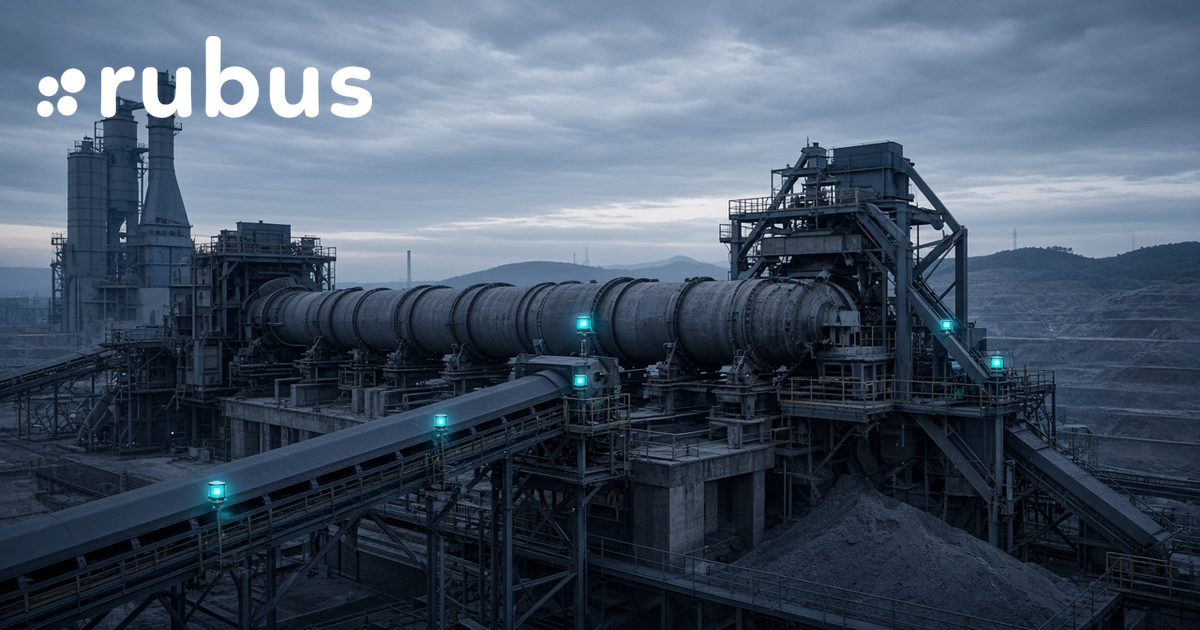
IoT in the cement industry is not a single gadget bolted onto a kiln. It is the combination of connected sensors and OT systems, edge connectivity, analytics, and digital operations tools that help integrated cement works monitor equipment, energy, and plant activity in near real time—and act earlier on downtime and inefficiency.
Plant OT/IT leads, reliability managers, and Industry 4.0 sponsors searching for cement industrial IoT solutions usually want a clear map: which use cases matter from quarry to packing, how OT–IT integration feeds condition monitoring and predictive maintenance, and how to evaluate a stack without a fake vendor ranking. This guide follows Rubus Digital’s published cement industry positioning—condition-based monitoring, predictive maintenance, energy consumption tracking, and emission-related visibility—without inventing case studies, ROI percentages, or customer names.
Why cement plants look at industrial IoT now
Cement plants run energy-intensive, continuous-process operations from quarry and crusher through raw mill, kiln, cooler, finish mill, packing, and utilities. Familiar pressure points follow: unplanned downtime on critical assets, OT data locked in PLCs, SCADA, and historians, reactive maintenance, and limited visibility into energy use and greenhouse emissions.
Industrial IoT (IIoT) helps when treated as connectivity plus monitoring plus analytics plus digital ops—not “sensors only.” A usable program moves plant signals into a governed path where dashboards, condition thresholds, predictive models, and digital logbooks share the same trusted feed.
What “IoT in the cement industry” actually covers
Cement industrial IoT solutions typically combine several layers. Solutions are platform and software capabilities; services are implementation, integration, and support. Rubus scopes both through conversation—there is no invented service catalog here.
Edge / OT connectivity and OT–IT integration
Most cement value starts at the edge. Multi-protocol interfaces collect signals from diverse OEMs. Store-and-forward keeps data moving when networks drop. Near-real-time exchange between operations and enterprise systems turns raw OT into usable context for KPIs, maintenance systems, and analytics.
Rubus frames this foundation as OT–IT integration with an OT–IT Bus / edge layer—multi-protocol acquisition, edge resilience, and a controlled handoff rather than an open pipe to the control network. See what OT–IT integration means for plant teams. Confirm protocol lists and deployment topology (edge, on-prem, hybrid, cloud) with product against your installed base.
Condition-based monitoring and predictive maintenance
With equipment data flowing, plants can move from calendar-only maintenance toward condition-based monitoring (CBM): thresholds, alarms, and trends on vibration, temperature, load, runtime, and related signals. Predictive maintenance (PdM) builds on that stream with anomaly detection and failure-oriented models so teams can intervene earlier.
Rubus’s cement page positions CBM and PdM as using real-time equipment data to reduce unplanned downtime and raise productivity—qualitative outcomes, not guaranteed percentages. The stack map is preventive and predictive maintenance plus the AI-ML Workbench. Related reading: AI predictive maintenance in heavy industry. Confirm kiln, mill, cooler, or fan model packages with product—no accuracy claims here.
Energy consumption and emissions visibility
Cement’s energy intensity makes consumption tracking a natural IIoT use case—see Rubus energy management for plant energy visibility patterns. Rubus’s cement page also describes tracking greenhouse emissions and acting on insights that support sustainability alongside reliable operations. That framing is visibility and actionable insight—not promised kWh savings or emission-cut percentages. Confirm data quality, metering coverage, and dashboard scope with product before locking sustainability claims into an RFP.
Digital operations (eLogbook) and the reliability loop
Sensors alone do not close the loop. Field teams still capture readings, incidents, meters, and faults. Rubus eLogbook digitizes those workflows with configurable logbooks, schedule-based execution, and service requests or work orders from inspection data—on mobile and desktop. That path connects IIoT monitoring to day-to-day cement ops.
See digital eLogbook vs paper. FRACAS / AMM workflows appear in Rubus’s product family; confirm cement-specific live workflows with product rather than assuming them for every site.
Cement process areas where IIoT typically helps
Applicability depends on instrumentation and OT connectivity—there is no claim that every cement asset is monitored. Common candidate areas include:
- Crushing and raw grinding — vibration, temperature, load, and runtime for CBM on crushers, conveyors, and mill trains.
- Kiln and cooler — continuous-process assets where early anomaly awareness and stable data paths matter (coverage confirmed per site).
- Finish milling — condition and energy-intensity monitoring on mills, fans, and drives.
- Packing lines — equipment health and fault logging that feed digital ops.
- Utilities — fans, compressors, and conveyors where energy intensity and condition data often reward attention.
Treat this as a use-case map for evaluation workshops, not a published Rubus cement asset inventory.
How Rubus approaches cement IIoT
Rubus’s cement framing centers on condition-based monitoring, predictive maintenance, energy consumption tracking, and emission-related insight for sustainability and reliable operations. A soft stack map:
- Foundation: Rubus IIoT Platform plus OT–IT Bus / Edge for multi-protocol connectivity and resilient handoff.
- Maintenance intelligence: Preventive / predictive maintenance with AI-ML Workbench / Rubus AI for anomaly detection and analytics.
- Ops digitization: eLogbook for readings, incidents, meters, and faults—with work-order follow-up where configured; FRACAS / AMM where confirmed.
- Energy: Visibility as described on the cement page—confirm dashboards, metrics, and integrations with product before promising outcomes.
Site context on rubusdigital.com includes 300+ connected device types, 35+ deployments, and 1250+ equipment integrated—marketing figures, not cement-only or independently audited results.
Buyer checklist for cement industrial IoT solutions
Use this checklist to structure demos and RFPs. It is not a ranked vendor comparison.
- Protocol and OEM diversity — Which PLCs, SCADA, historians, and sensor classes must the edge cover on day one?
- Edge resilience — Is store-and-forward and local handling available when links fail?
- CBM to work-order path — Do alarms and inspections create actionable maintenance follow-up (e.g., via eLogbook / AMM / CMMS)? Confirm connectors with product.
- PdM model lifecycle — How are models trained, validated, and owned over time? Confirm with the AI-ML / PdM team.
- Energy and emissions data quality — Meter coverage, calculation methods, and dashboard scope—confirm before sustainability commitments.
- Multi-site dashboards — Can the same pattern scale across works if you operate a network of plants?
- Cybersecurity and authentication — High-level expectation: controlled OT–IT handoff and authenticated APIs; detailed architecture with your OT security owners.
- Change management — How will kiln, mill, and utilities crews adopt digital logs and new alert workflows?
Frequently asked questions
What is IoT in the cement industry? Using connected sensors and OT systems, edge connectivity, and analytics so cement plants monitor equipment, energy, and operations in near real time and act earlier on downtime and inefficiency.
What are cement industrial IoT solutions? Stacks that typically combine OT–IT integration, condition monitoring, predictive maintenance, digital logbooks, and often energy or emissions visibility—not a single device.
How does IoT help cement plant predictive maintenance? Continuous equipment data enables CBM and AI/ML models that detect anomalies and support earlier maintenance decisions. See Rubus’s preventive/predictive maintenance and AI-ML pages; no invented accuracy rates.
What equipment can IIoT monitor in a cement plant? Common candidates include mills, kiln/cooler trains, fans, conveyors, compressors, and packing lines—only where instrumentation and connectivity exist.
How does OT–IT integration support cement IIoT? It bridges plant OT (PLC/SCADA/sensors) with IT, analytics, and enterprise apps so data is usable for dashboards, PdM, and ops tools.
Can industrial IoT reduce cement plant energy use? Rubus positions energy consumption tracking and actionable insights on its cement page. Confirm product energy features before claiming savings or emission cuts.
What is the difference between cement IoT solutions and services? Solutions are platform and software capabilities; services are implementation, integration, and support. Scope both with Rubus for your plant.
Does Rubus offer IoT for cement? Yes. See the cement industry page plus the IIoT platform, OT–IT Bus, PdM/AI-ML, and eLogbook offerings on rubusdigital.com—then contact Rubus for fit and scope.
Next step
Evaluating cement plant IIoT—from OT connectivity through PdM and digital ops? Start with Rubus’s cement industry overview, then explore condition monitoring, energy management, OT–IT Bus, predictive maintenance / AI-ML Workbench, and eLogbook for your quarry-to-packing context. Request a demo or contact us to scope a walkthrough around kiln, mill, utilities monitoring, and energy visibility.




%20(3).png)

